It has been a week since I moved all the fish to the quarantine, and they look great. Dory the blue tang has recovered and swims (upright :)
The main display tank is now fish free, and I noticed a bloom of little white spots on the glass and the overflow box. Since I couldn't tell what they were, I asked my husband to photograph them with his macro lens setup. It was a crazy setup with tripods, electronic motors, switches, lights, and of course, a very nice camera and lens. Here is what we found in the tank:
Sadly, my fish have come down with the parasite Ich! The telltale signs are the tiny spots stuck to the fish. I tried adding a cleaner shrimp to the display tank. Cleaner shrimps are very pricey!
Cleaner Shrimp
It immediately started to clean my flame angel.
Flame Angel at cleaning station
However, cleaning the fish does not help rid the display tank of ich. Since I have corals and invertebrates, I cannot use any medications in the display tank. The LFS advised me that the so-called "Reef-safe" treatments are too weak to be effective. The only option is to move all the fish to a quarantine tank, treat the infected fish there, and let the parasite die out in the main tank. This should take 4-6 weeks for the ich's life cycle to complete. Leaving the main tank fish-free is the only way to ensure all traces of the parasite die off. [sigh]
I set up a 10 gallon tank with a hood, heater, filter (without media), and pieces of PVC for the fish to hide in. No sand or rock since they absorb the treatment product...copper. The clownfish and Blue tang were fairly easy to catch. It took hours of ripping apart the rocks in the display tank to catch the Flame Angel and Orange Spotted sandsifting Goby. I moved all the fish to the display tank, and now begins this 6 week wait.
Quarantine tank. I did replace the live rock with more pieces of PVC
Dory infected
Orange Spotted Goby before moving it to the Quarantine tank
I am kicking myself for not placing all new fish in a quarantine tank for 4 weeks before introducing them to the main tank. Eagerness to see them swimming among all the rocks and coral I guess. Big lesson learned!! Sadly, my gorgeous Flame Angel did not not make it through its first night in quarantine :(
I had 3 branches of a pink & white Xenia. I had it nestled nicely in between the rocks and it grew for several weeks. Then one day, two of the branches withered up and died. The third branch died the next day. I'm not sure what happened. The only thing I can think of is that the salinity level of the water dropped from 1.025 to 1.021. My fault, I forgot to add the salt when I did a water change. It is rather ironic that I managed to kill a coral that others have complained grows like a weed. Has anyone had a similar experience?
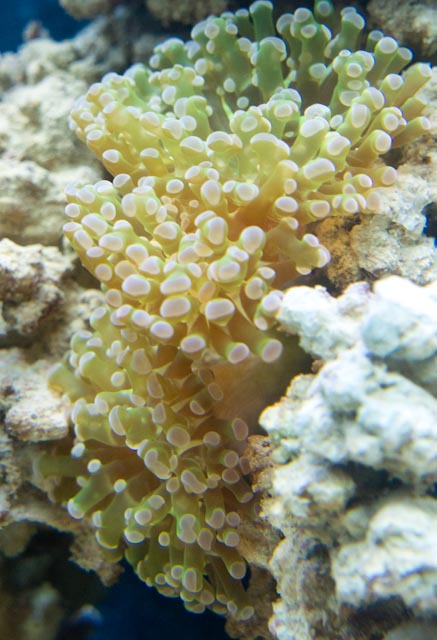
Here is a picture of a Frogspawn coral. It has 3 branches, and has been growing nicely. I believe it has a slight sting, so I keep it away from other corals.
My very first coral purchase was a large, expensive piece of flower pot coral. Its Latin name is Goniopora, which is a stony coral with large polyps. It is not surprising that I would be drawn to a coral that looks like flowers. Unfortunately, I did not do my research prior to my impulsive purchase, and did not realize it is a difficult one to keep alive.
This coral does contain the symbiotic algae zooxanthellae, which means it uses photosynthesis to create its nutrients. However, I have read that this particular coral should be fed with a product such as micro-plankton.
My second mistake was dropping it on its "face" when I tried to position it in the tank. That it did not like. The polyps retracted and released a coating of slime. I was sure it was a gonner.
I immediately ran out to buy some zooplankton and fed it using a turkey baster. After a few days of nursing it, a third of the polyps came back. Then another third, and finally all of it. It now looks like this.
It is a shocking transformation! It is by far my favourite coral in the tank, and I hope I can continue to keep it alive. By the way, I found that placing it on the sand bed, and away from strong currents works best.
One fascinating thing I witnessed was it releasing some sort of stringy substance from the centre of each polyp. Here is a video.
There is even an acronym for these...CUC. Fish can be a little messy when it comes to food, and it's the cleanup crew's job to eat.
First came two peppermint shrimp. What a pain these are! They are nocturnal, and spend most of the day hiding behind rocks. I only saw both shrimps during the first few days, and then there was only one. It has been a month now, and I am convinced one ate the other. The shrimp is amazing for sniffing out food and hauling it off. Unfortunately, it has a voracious appetite. I actually need to feed it, otherwise it terrorizes other things. I have seen this shrimp pounce on some of my soft corals (torch, button, frogspawn). I don't think I would have bought these had I known their behaviour.
Peppermint shrimp with some Red Button Polyp coral
Next came the hermit crabs. These guys are a lot of fun. From the moment I bought them, they have been working to clean up the rocks and sand. They also eat fallen food. I bought 4 blue, 1 white, and 1 red legged. I am not sure how the white one ended up in the batch. They also have a voracious appetite, and I feed these as well as the shrimp.
Hermit crabs
I soon discovered I had an algae bloom. The brownish stuff was all over the rocks, glass and sand. So next came the snails. I bought 2 Trochus, 7 Nassarius. They have been doing such a great job, that I'm running out of algae. I will need to fed them as well. The Nassarius also keep the sand stirred, which is nice.
Trochus snail, with a torch coral and a toadstool coral
Small Nassarius snail scooting away from the crabs
It has now been a month since I setup the tank. It has fully cycled, and water quality is great! PH 8.2, no Ammonia, Nitrites or Nitrates. Now for the fun part.
Here is the tank with the rock in place.
I purchased two Percula clownfish. They are of course named Nemo, and Nemo's dad. They're more likely to become a mating pair, but for now, it makes my daughter happy. Strange thing, I purchased some soft corals for them to live in (rather than anenomes which can sting), but they would rather just swim around.
This one is Nemo. He even has a gimpy fin. Notice the hole in the dorsal fin.
Then came a small Blue Hippo Tang, named Dory. What a peculiar fish. At first she was freaked out and hid in the rocks for days. I thought she was a gonner. But she now comes out and swims with the two clownfish. Peaceful, except when it is dinner time. She won't grab the food off the surface, but waits for the clownfish to eat, and then yanks the food out of their mouths. She is feisty!